Padel Court Surface Guide for Travelers
Learn about padel court surfaces, from sand-filled turf to acrylic. Understand grip, bounce, and shoe requirements for your next padel holiday.
What a Padel Court Surface Is
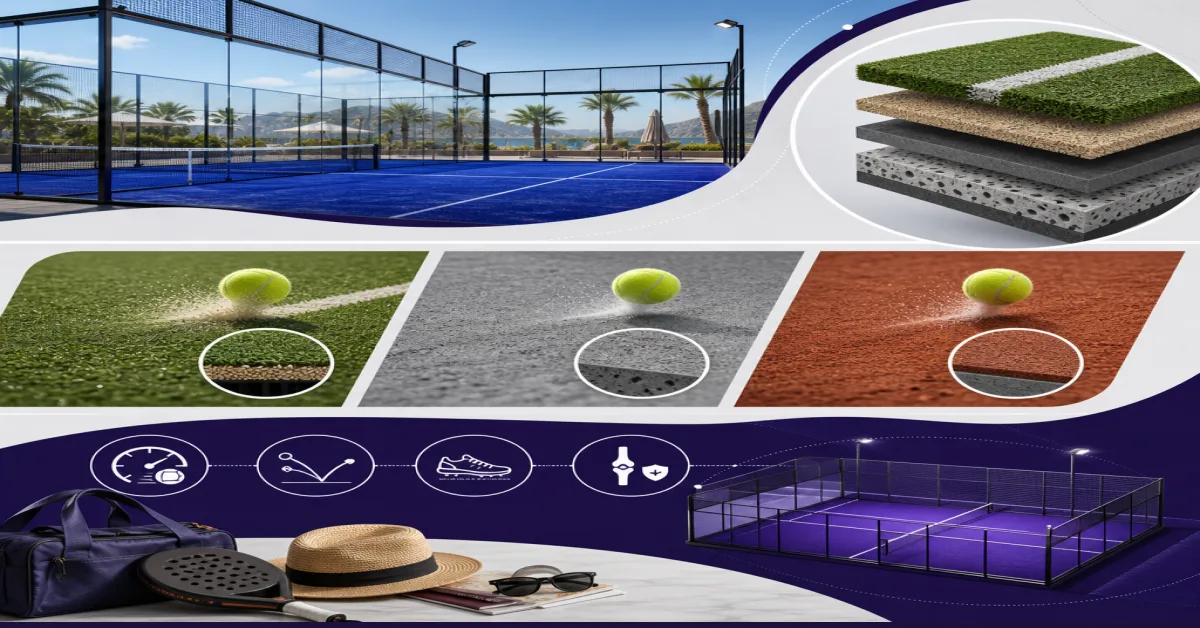
A padel court surface is the artificial turf, typically sand-filled or sand-dressed, laid over a porous base and enclosed by glass walls and metal mesh, which together determine the speed, bounce, grip, and shoe requirements of the game. The flooring system (turf, sand infill, and porous base) is distinct from the enclosure (glass walls and metal mesh). This sand-dressed or sand-filled turf over a porous base is the dominant tournament-style and holiday-play surface you will encounter.
The court itself is a compact enclosed space, commonly cited as 10×20 metres, which keeps rallies tight and fast. The porous base beneath the turf is what allows water to drain through rather than pooling on the surface, which is why this construction works so well for outdoor holiday play. For context, Golden Point Padel Holidays delivers fully arranged holidays, pairing competitive accommodation with prebooked court times, coaching, and activities, all confirmed before you travel, with bookings handled by the booking partner.
Sand-Filled and Sand-Dressed Artificial Turf: The Holiday Default
Most holiday venues use standard blue or green artificial turf that is sand-filled or sand-dressed over a porous base, designed for drainage and outdoor play. The sand infill is the key variable you will feel in your first games. Heavier, evenly spread sand produces more control and a slower pace, while thin or uneven infill can feel skiddy with variable bounce until the sand settles. Courts that see heavy daily use may have compacted infill, which can make the surface play slightly faster than a freshly dressed court.
What you will feel on a typical holiday court:
Consistent grip underfoot, allowing confident directional changes and slides.
A predictable, moderate ball bounce that suits controlled rallies and smashes.
Slower ball speed compared to hard surfaces, giving you more reaction time at the net.
Underfoot comfort that reduces joint strain during multi-hour sessions.
A slight cushioning effect from the sand layer that hard courts simply do not offer.
Golden Point vets every package for court quality, so the courts in your holiday package are matched to this standard play surface, not a lower resort substitute.
How Turf Compares with Acrylic and Concrete for Holiday Play
Sand turf is the usual holiday surface; polypropylene or acrylic and concrete or asphalt are minority options, and natural grass is not the holiday norm. The table below compares these surfaces by play feel only, ranked by how likely you are to meet them on a trip.
| Surface | Speed | Bounce | Grip | Shoe Implication | Typical on Holidays? |
|---|---|---|---|---|---|
| Sand-Filled / Sand-Dressed Artificial Turf | Moderate to slow | Predictable, medium height | High, allows sliding | Non-marking padel shoes recommended | Yes, the standard |
| Acrylic / Polypropylene | Fast | Low, skiddy | Lower, risk of slipping | Non-marking court shoes essential | Rare |
| Concrete / Asphalt | Fast | High, hard | Low, unforgiving | Court shoes with strong lateral support | Very rare |
Padel turf is not a tennis hard court. It plays slower, offers more grip, and is far gentler on the knees, so bring expectations set for padel, not tennis. If you do encounter an acrylic or concrete court on holiday, expect a noticeably faster game with less margin for error on your footwork — adjust your shot selection accordingly in the first few games.
Indoor, Outdoor, and Covered Courts: Bounce and Weather Reliability
Indoor Courts
Uniform, predictable bounce unaffected by wind or moisture. Most reliable option for consistent play.
Outdoor Courts
Porous base drains quickly, but can play slightly faster in dry, warm conditions. Humidity adds grip.
Covered Courts
Roof removes washout risk entirely. Best for shoulder-season travel and rain-prone periods.
Many holiday venues use compact, often covered courts, so weather rarely cancels play. The main difference you will notice is bounce consistency: indoor and covered courts offer a uniform, predictable bounce unaffected by wind or moisture, while outdoor courts on a porous base drain quickly but can play slightly faster in dry, warm conditions. Humidity can also make outdoor turf feel grippier underfoot, while heat softens the turf pile slightly and can slow the ball marginally.
For planning, treat covered courts as the most reliable option. Panoramic versus classic describes the enclosure and wall configuration, not the playing surface, so it does not change how the ball reacts. What matters for your holiday is that a porous base provides drainage on outdoor courts, and a roof or cover removes washout risk entirely. If you are booking a summer holiday, outdoor courts are rarely an issue; for shoulder-season travel, a venue with covered courts gives you greater certainty that every session goes ahead.
What to Expect at a Holiday Venue
Most holiday venues use the standard blue or green artificial turf, and some premium resorts have on-site courts, including ILUNION Miramar, Monarque Fuengirola Park, W Algarve, and Hyatt Regency Vilamoura. These on-site courts match the standard surface described throughout this guide, so you can step off your sun lounger and onto a familiar playing surface without adjusting your game.
Named clubs in Golden Point packages follow the same pattern:
Costa del Sol
- Club La Colina Torremolinos
- Ático Pádel Torremolinos
- La Finca Club de Padel
Algarve
- Alvor Padel Club
- Clube de Tenis e Padel de Lagos
- Vilamoura Tennis & Padel Academy
Manchester
- Carbon Padel Club
- Club De Padel
- Pure Padel Manchester
These clubs are illustrations of the typical holiday surface, not reviews, and no surface claims beyond the standard turf pattern should be assumed for any individual venue. Most of these clubs also offer racket hire on site, so even if you travel light, you can still play to a good standard.
Grip, Speed, and What to Pack: Non-Marking Padel Shoes
Non-marking padel shoes are recommended, and most clubs require them. The right shoes lock your grip to the turf, letting you push off, slide, and change direction without leaving marks or losing traction. Padel-specific soles use a herringbone tread pattern designed to grip sand-filled turf without catching or sticking, giving you the controlled slide that padel movement demands.
Packing Checklist
Non-marking padel shoes with a herringbone or padel-specific tread pattern.
Court shoes with strong lateral support if you do not own padel-specific footwear.
Avoid tennis trainers that mark courts or lack the grip pattern padel turf requires.
Break in new shoes before your trip to avoid blisters during multi-hour sessions.
Pack a spare pair of socks for back-to-back daily play in warm climates.
Equipment hire is typically included in the package, but bringing your own padel shoes ensures the best fit and performance from the first game. For a full rundown on rackets, balls, and other gear, see the Padel Equipment Guide.
How Golden Point Holidays Match You to Vetted Courts
Vetted Quality
Over 400 resorts across 50+ destinations, every package checked for court quality, accommodation, and experience.
Prebooked Courts
Court times are secured and confirmed before you arrive, so no waiting for free slots or hoping for availability.
Fully Arranged
Competitive accommodation, coaching, and activities all confirmed before you travel. Bookings handled by our partner.
Golden Point Padel Holidays delivers fully arranged holidays, pairing competitive accommodation with prebooked court times, coaching, and activities, all confirmed before you travel. Because of the volume of bookings we process, we secure priority bookings at the most competitive rates with both hotel partners and padel courts.
We partner with over 400 resorts across 50+ destinations, and every package has been vetted for court quality, accommodation standards, and overall experience. That means the surface you play on is checked before you arrive, so the turf, bounce, and grip match the standard described in this guide. Court times are prebooked and confirmed in advance, so you are not left waiting for a free slot or hoping a court is available when you arrive. Bookings are handled by our booking partner, and Golden Point Padel Holidays is the brand that arranges your trip.
Frequently Asked Questions
What is the best type of flooring for a padel court for holiday play?
Sand-filled or sand-dressed artificial turf over a porous base is the best flooring for holiday play because it offers predictable bounce, good grip, and drainage for outdoor courts. It is also the most common surface at holiday venues, so your practice on turf translates directly to your holiday games.
Is sand-filled artificial turf the standard padel court surface?
Yes, sand-filled or sand-dressed artificial turf over a porous base is the dominant tournament-style and holiday-play surface you will find at most clubs. It is the surface used for professional tour events and the overwhelming majority of recreational play worldwide.
How does a padel court surface differ from a tennis hard court?
Padel turf is slower, offers more grip, and is gentler on the knees than a tennis hard court, which is faster with a lower, skiddier bounce. The sand infill in padel turf absorbs impact and creates the medium-height bounce that padel tactics depend on.
Are padel courts the same size as pickleball courts?
No, padel courts are not the same size as pickleball courts. Padel courts are commonly cited as 10×20 metres, while pickleball courts are significantly smaller at approximately 6.1×13.4 metres. Padel courts are also fully enclosed by glass walls and metal mesh, whereas pickleball courts are open.
Do I need special shoes for padel court surfaces?
Yes, non-marking padel shoes are recommended, and most clubs require them to protect the turf and provide the grip needed for lateral movement and slides. Running shoes or tennis trainers lack the lateral support and tread pattern that padel movement requires.
Do indoor and outdoor padel surfaces play differently?
Yes, indoor and covered courts offer a uniform bounce unaffected by weather, while outdoor courts on a porous base drain quickly but can play slightly faster in dry, warm conditions. Humidity and heat can also subtly affect grip and ball speed on outdoor turf.
Will weather cancel outdoor padel on a holiday?
Rarely, because many holiday venues use compact, covered courts, and outdoor courts with a porous base drain quickly after rain, so play can resume shortly after showers pass. In peak holiday seasons, the risk of prolonged rain cancellations is very low across the Costa del Sol and Algarve.
What padel court surface will I play on with Golden Point Padel Holidays?
You will play on standard blue or green sand-filled or sand-dressed artificial turf at vetted clubs, with court quality confirmed before you travel as part of your fully arranged package. Every court in our network has been checked against the standard described in this guide.
Ready to Play on the Best Courts?
Book Your Padel Holiday Today
Explore our curated packages and play on vetted, tournament-standard padel surfaces across the Costa del Sol, Algarve, and beyond. Everything arranged before you travel.